
Maintenance Issues and Requests for Leech Lake Public Housing
Figure out if you’re having a maintenance emergency
EMERGENCY → call 218-888-2936
➢ No heat
➢ No water or hot water
➢ Electrical problems
➢ Broken water lines
➢ Clogged toilet if you only have one toilet
➢ Sewer backing up
➢ Frozen pipesNOT an emergency → written request
➢ Clogged toilet, if you have more than one toilet
➢ Leaky sink
➢ Pest control
➢ Anything else
Make your request here: https://llboha.org/maintenance-inspections/#MaintenanceHow to make a maintenance request if there is not an emergency To make a repair request, make sure it is in WRITING. If you see your maintenance person or property manager at Walmart and ask them to fix something, that doesn’t count. It is important to write things down. When you submit a request, be as detailed as possible. Instead of saying, “There is mold in the bathroom,” try saying, “There is mold in the bathroom. It is on the floor, going up the wall. It starts from the base of the tub in the corner furthest from the toilet.” This will help things get fixed as easily and quickly as possible. Remember to take pictures! Take your pictures be in color and have a wide angle. Try not to have anyone or anything other than the problem in the photo. With the examples below, instead of the one on the Right, try to aim for the one on the next page. Keep the photos you take for possible future use.
If your repairs still haven’t been made two weeks after you submitted the written request, go ahead and request again. This time, also write down on a notepad or your phone’s notes app the dates of both times you’ve requested repairs. Keep this log updated anytime you make an additional request about the same problem.
Other things to know There are certain things the Leech Lake Housing Authority will fix at no charge. If it is routine or non-routine, the Housing Authority will schedule a time and fix it. If the damage is due to misuse of the space by you or one of your guests, you will have to pay for the repair. For example, the Housing Authority will pay to fix a broken water pipe but will not pay to fix the carpet that a dog has torn up.
Leech Lake – The Dog Ordinance
If you live on the Leech Lake Reservation, you have probably heard of the dog ordinance. You must follow it to protect your dogs and yourself. If you violate the dog ordinance, you can be fined up to $10,000 if your dog attacks someone.
The Leech Lake Tribal Council took notice that dogs were a public health and safety risk in parts of the Leech Lake Reservation. To better protect the health, safety, and welfare of the people, livestock, and game on the Reservation, they created the dog ordinance to control the dog population.
To control the dog population, the Tribal Council requires that any dog living on the Reservation must be registered by its owner with the Leech Lake Public Safety Division. There is an annual registration fee of $10.
It is important you understand what is considered a “dangerous” dog. A dog is considered dangerous when it does any of the following without being provoked
- Causes substantial harm to a human
- Kills a domestic animal
- Cases or approaches a person upon the streets, sidewalks, or public grounds in a frightening way
A dog is also dangerous if an enforcement officer finds the dog to be dangerous and the dog bites, attacks, or endangers humans or animals or if it has been used in dog fighting.
If your dog is dangerous, you must prove you have insurance with a $50,000 liability limit to cover any damages that the dog might cause. Rottweilers, pit bulls, Dobermans, shepherds, and or any dog mixed with any of those breeds must also have $50,000 in liability insurance.
Please note that the Leech Lake Housing Authority has recently created a strict one-dog-per-household pet policy. If you live in Leech Lake public housing and have more than one dog, please be aware of this. They will conduct home visits to arrange the collection of a $50 fee. If they find you have more than one dog, they might get you time to give the others away, or they might seize them on the spot.
If this happens to you, Please call Anishinabe Legal Services at 218-335-2223 to complete an intake.
Bed Bugs and Roaches: How to Deal with Pests in Your Apartment
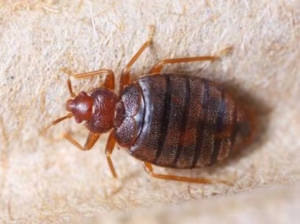 Identifying a Pest Problem
The three big pests everyone should know to look out for are mice, roaches and bed bugs. Most people are familiar enough with mice and roaches to identify them but less are familiar with bed bugs. So, I’ve included an image of one of the little bloodsuckers. While seeing any one of these is a surefire way to notice a problem, looking for other signs can help identify the problem earlier. For mice and roaches, look for signs of their dropping around pantries, kitchen cabinets and bathrooms. Mice droppings will be more pointed, while
roaches will have more rounded droppings. These often resemble coffee grounds or small black spots. For bed bugs, check underneath your sheets near the corners of your mattress and box frame, and even your headboard. Seeing small black spots on the mattress and red spots on yourself when you wake up mean you probably have bed bugs.Fixing the Problem
Once you identify you have a pest issue, you need to put in a maintenance request with your landlord, in writing, just like any other maintenance request. If you’re in private rental housing, you can make this request by writing directly to your landlord. For White Earth public housing, work orders need to be submitted by calling 218-473-463. For Leech Lake, these requests are done through the form found at this link (https://llboha.org/maintenance-inspections/#Maintenance). Taking pictures will help make sure your landlord responds to the issue quickly. Your landlord will have 14 days to address the problem. If they haven’t addressed the problem within that time, make another request. Save all your requests just in case the problem continues to go unsolved.Most likely, your landlord or housing authority will get pest control specialists in your apartment as soon as they can to assess the problem and figure out how to remove all the pests from the property. Make sure to listen to your pest control technician about how to make sure treatment is successful, and how to prevent the same problem in the future.
Prevention
While identifying and solving pest issues is important, preventing them in the first place is always a good idea! Checking for bed bugs whenever you travel can help make sure you don’t accidentally take them home with you. And making sure you don’t have holes bigger than the diameter of a pencil, your food is properly stored, and regularly clean so you spot any signs early. All of these pests can cause health issues, and nobody wants to deal with them. Take these simple preventative measures.What to Do When You Have Problems with a Neighbor
Most renters live in close proximity to their neighbors, and this closeness can lead to conflicts. Often, these conflicts are about noise or smoke, but they could also be related to unruly pets or even plain old scary behavior. But what are you supposed to do when you have a problem with a neighbor?
First, the best-case scenario is working out the problem with your neighbor. So long as you don’t think your neighbor is a threat to your safety, calmly discussing the issue is often the best way to resolve the issue. It is best to approach these conversations in a calm and friendly manner, and to avoid casting accusations or blame. IF you can manage this sort of friendly conversation, there is a good chance you can find a solution to whatever problem there is that works for everyone involved.
However, if you can’t work out the problem directly with the neighbor or feel unsafe talking to them, then you’ll need to look at alternative options for addressing the issue. If you and your neighbor share a landlord, bringing the problem to the landlord may be the next best option. Most leases require tenants to avoid disturbing any neighbor’s peaceful enjoyment of their property. If this is the case, your neighbor may be in violation of their lease due to their obnoxious behavior. Keeping a record of the disturbances, when they happened, and how they impacted you can be a great way to make sure your landlord understands the extent of the issue and can takes steps to address it.
If your neighbor is not renting from the same landlord, or even is the owner of the neighboring property, there may still be some legal options available to you. Many communities have homeowners’ associations or city ordinances which contain noise ordinances or requirements on lawn maintenances. If you find that your neighbor is violating these ordinances, you can contact the HOA or your city’s code enforcement department.
However, if your neighbor is acting threateningly, is causing damage to property, or you have reason to believe they have been engaging in illegal activity, involving the police may be your best option. You do not need to reveal that you are the neighbor when you inform police, but there is a good chance they ask you questions when you arrive. If you can document evidence of your neighbor’s criminal activity (i.e. through pictures or a doorbell camera), this will reduce the likelihood for police relying on you as a witness. This can be beneficial, as it means you calling the police is less likely to be revealed to the neighbor.
Move-In Checklist
If you live off the reservation, you have a right to this initial inspection under Minnesota state law!If you’re reading this post, you’re probably about to move into a new apartment or rented home. This post will give you some tips on how to set yourself up for success if anything goes wrong during your time in your new place.
Once you move in, one of the first things you’ll want to do is an initial look around for any damage that was there before you moved in. The point of this initial inspection is to identify issues with the unit that were there before you moved in, so that you are not charged for them when you move out. In other words, this step helps in trying to keep your security deposit.
If there is not a formal move-in inspection with your landlord, you can do your own. Your landlord might give you a checklist, or there are some good options online. Otherwise, you can make note of any pre-existing damage.
In the first few days of moving in make a list electrically or by hand. Write (1) your name (2) your address and (3) your move-in date. Then, go through your new unit very carefully. Break the list into subsections by room and note any issues that were there before you moved in. For example:
Hallway Bathroom Kitchen Scuff on the floor by the front door Crack in tile next to the sink Lack of caulking on the bathtub
Scratch on the fridge Go room by room and note anything that is not in great condition. Attention to detail here is important. If you don’t note it now, your landlord can take the cost for repairs out of your security deposit when you move out. Take date-stamped pictures for extra security. Make sure the pictures are in color, use a wide angle to show exactly what and where the problem is, and ensure nothing is distracting from the issue in the photo. Make sure you have two copies of this self-inspection. Send one to your landlord for their files and keep the other for yourself. Keep any texts or emails that you sent your landlord the self-inspection. If you follow these steps, you shouldn’t be charged for any damage to the unit that was done before you moved in. Contact an attorney if there is a disagreement about damages when you move out. Any damage beyond wear and tear is the responsibility of the tenant.
Social Contact